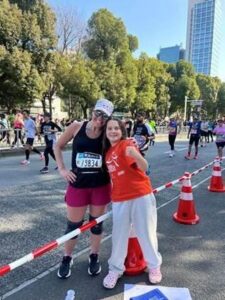
By any metric, 2020 was a difficult year for everybody. For Fairfax, Virginia, mom Madeline Campbell and her daughter Lulu, 12, it was an especially trying time. At Lulu’s sixth birthday wellness child checkup, her pediatrician noticed something unusual. “[The pediatrician] was just listening to her heart and it sounded a little funny,” Campbell says. “So, they referred her to an electrophysiologist … who referred her to an even better one, and so it went up the chain pretty quickly.”
After a battery of tests with a variety of doctors, Lulu was diagnosed with long QT syndrome (LQTS). LQTS is a heart rhythm disorder characterized by fast and irregular heartbeats, which can lead to heart palpitations, fainting, cardiac arrest and seizures. With appropriate medical care and monitoring, those with LQTS can live a regular lifespan.
All in the Family
Since LQTS is often genetic, Campbell and her entire family tested for the disorder. Not only does Madeline have the disorder, but so does her mother, her sister and her sister’s children. Lulu’s twin brother, Philip (who goes by Flip) does not have LQTS. Both Campbell and Lulu’s LQTS symptoms are mostly exercise and adrenaline -induced.
With proper management, Campbell and Lulu are now able to live their lives with relative normality. One of the most common treatments for those with LQTS is a beta blocker to lower the heart rate. Campbell was prescribed a low dose of SSRIs to help get her symptoms managed.
Campbell, who describes herself as, “super active,” found that the beta blockers made her heart rate too low when doing physical activities. After exploring several options and discussing the best course of action with her medical team, in August 2025 she elected to get a leadless pacemaker, which can be adjusted with digital controls externally with a simple doctor’s visit.
Lulu, who is now in seventh grade at Robinson Secondary School in Fairfax, manages her symptoms with beta blockers, being aware of how her body feels, staying well hydrated and monitoring her level of physical activities, particularly in hot weather.
Running to a New Heartbeat
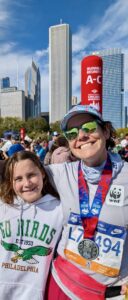
Mother and daughter are determined not to let their diagnoses get in the way of living normal lives full of fun. Since her diagnosis, Madeline Campbell has run several marathons and Lulu is one of her most enthusiastic supporters. “She’s my biggest cheerleader. She calls me ‘Mommy fast feet,’” Campbell says. She’s always “just encouraging me [with] the funniest, very tween slang that I don’t fully understand. But she is so excited and encouraging, and I think part of it is the real sense of adventure that comes with the freedom of just going out and running.”
Up next is the New York City Marathon in early November. Campbell will be running with Team Abbott, the company who makes the pacemaker she had put in last year.
“It feel really adventurous, and it feels really meaningful to have that shared experience. [Lulu] came with me to Tokyo. She came with me to Chicago, and she’s coming with me to New York.”
In addition to Lulu, Campbell finds that Flip is always on top of his game to make sure his mom and sister are being smart and safe about their LQTS. “He is definitely our worrier in a good way,” she says. “He is really athletic himself and really is excited about getting a [personal record], but also when I suggest a change in my routine, he’s like, ‘You need to talk to your doctor first, Mom.’”
Looking Ahead With Gratitude
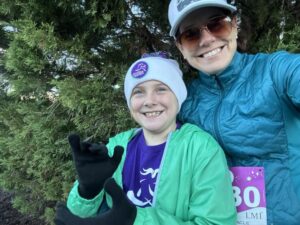
Children’s National Hospital in Washington, D.C. has programs for children with LQTS, and Lulu is an active participant in as many of the programs. “Lulu and I are going to a family camp for kids that have the same diagnosis,” says Campbell.
Despite the difficulties and unknowns of LQTS, Campbell finds herself grateful for the diagnoses that she and her daughter have. “We seem to be living pretty full lives, so it [doesn’t] feel like a tragedy,” she says. “One of my very best friends from high school died of long QT right after she had her baby … she was undiagnosed and was diagnosed after she died.”
With LQTS, the first symptom of the disorder can be sudden onset cardiac arrest. “It feels like such a blessing that there was a great pediatrician who really followed through on what she was hearing in Lulu’s heart,” she says.
One plus that Campbell sees in the LQTS is learning how to better advocate for herself and teaching her daughter to do the same. “For the first time ever, I’m actually submitting a reasonable accommodation request [at work],” she says.
It is easier, Campbell says, to teach Lulu how to be her own best advocate if she models that behavior herself and sets that example.
In addition to advocating for their needs more, Campbell and Lulu have learned to take note of their surroundings and make sure they are doing the necessary extra things to keep themselves safe. When she goes for runs, Campbell wears a medical alert bracelet, stays well hydrated and makes sure to listen to her body, especially in the heat. When possible, Campbell makes sure that she and Lulu go to places with defibrillators on site whenever they are exercising.
As to the future, the possibilities are endless. Campbell hopes to run all of the remaining major marathons. “So, after New York, I’ll have Boston, London and Berlin,” she says. “Then, they’ve expanded to also have one in Cape Town and Sydney.”
Campbell wants to make sure that, with care, Lulu can do anything she wants. Her running “is not just about me getting my workout in,” she says. “It’s about me kind of sharing messages with Lulu, and sharing strength with Lulu and learning from Lulu and her fearlessness, and adventure and all of her pursuits.”