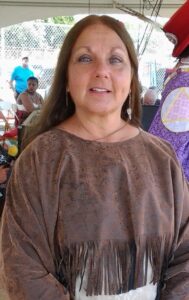
Chief Donna Wolf Mother Abbott is the first woman chief of the Nause-Waiwash Band of Indians, a community of about 300 people descended from the Nanticoke and Choptank Indians. The band was officially formed in the 1980s to preserve Dorchester County’s Native American history and culture by Abbott’s predecessor, Chief Sewell Winter Hawk Fitzhugh.
Since the official founding of the Nause-Waiwash Band of Indians, the group has hosted an annual Native American Festival for the past 32 years, as well as participating in events like the Baltimore American Indian Center’s Annual Pow Wow and supporting initiatives to aid Dorchester County Public Schools. As the tribe places a significant emphasis on education, Abbott and other members often speak at public events about their history, culture and traditions. Abbott recently spoke at the Montpelier House Museum in Prince George’s County on Indigenous Peoples Day.
Now 60, she lives in Cambridge and has an adult son. For Native American Heritage Month, here’s what she has to share with families, including how to introduce kids to Native American culture.
Tell me a bit about your background and what it was like being raised in an indigenous community.
I was raised in Dorchester County, and being [American] Indian was something that I always knew I was. It just wasn’t anything we went around shouting from the rooftops. Growing up, my father, my grandfather and my uncle all still hunted and trapped and worked with water, and a couple of times, we went and harvested asparagus on the side of the road and cut our own Christmas trees. We had our own gardens. And to me, that was our normal way of life.
You’re the first woman chief of the Nause-Waiwash. What does that role mean to you?
I’m very honored that my people chose me. It’s a lifetime position, unless the women of the tribe decide I’m not doing my job. We are matrilineal, so the clan mothers and women make the major decisions. My predecessor was put in place by the women of the tribe. When he passed, that seat opened up.
I was asked by a couple of our elders if I could run in the chief election, because I had worked so closely with Chief Winter Hawk. I was hesitant to do so, because I’d seen some of the struggles he’d gone through. But I knew that if I didn’t at least make an effort, all of the hard work he had put into the tribe, along with the founding fathers and elders, would go to waste. I didn’t want to see that happen. It wasn’t necessarily about me personally, but about keeping the tribe going and keeping its history alive.
You often speak about the Nause-Waiwash and their history at community events.
I try to oblige anyone who asks me to speak, because I feel it’s very important to get the exposure and for people to understand that Indian descendants are still here, that the race was not completely annihilated. I do a lot of talks at schools and museums, and it’s very much on me to do them because we’re matriarchal. We hold women and their voices in very high regard because women give life, so they’re higher in the chain.
How do you keep your tribe’s traditions alive in your family and community?
One of the ways we do that is at our annual festival. We just celebrated our 32nd year, and we try to show our own culture and traditions as well as having other tribes come to share their beliefs and traditions as well. Those of us that are still active in the community still trap, still hunt, still work the waters. It’s a way of keeping our traditions alive, but also a means of survival. We’ve done it for generations, and people still do it today as a means of providing for their families.
Are there any ways in which you feel education around Indigenous people, such as at public schools, can be improved?
Last summer, the Maryland State Archives, [Maryland State] Department of Education and Maryland Humanities all got together and came up with this program. They invited educators from the four lower counties—Dorchester, Wicomico, Somerset and Worcester—librarians, schoolteachers, college professors, all of them. And they also invited the chiefs of the other local tribes, the Assateague People of Delmarva, the Pocomoke Indian Nation and the Accohannock Indian Tribe, to tell our own stories, which is something we’ve been trying to do for years. These educators sat in on us sharing our story and came up with a curriculum that they want to use in the public schools in the area. They kicked it back to the chiefs to review it for accuracy, and we signed off on it. Hopefully in the next school year or the one after that, schools will start using it, and it’ll be available to educators. This is something new. They’re hoping that other school systems will catch on and start doing the same thing.
Do you have any suggestions for parents who want to connect their children with Native American education and culture, but might not know where to start?
It’s a tough question, and a lot of organizations are struggling to get young people involved. But I have found recently that if you give [young people] something to do, they’ll be more likely to respond. My son is from the generation of technology, so we made him the Nause-Waiwash Band’s social media manager. It’s the perfect job for him, and he doesn’t mind doing it since he grew up using computers. So, you have to look to give people a job, or something to do.
For little kids, I’ve often recommended starting a little garden. Kids like gardens. They like to see things grow. I often suggest native plants with Indigenous history, like sweetgrass. You can plant a garden of sweetgrass with your kids and teach them how it’s used medicinally by the Native Americans of this area, and how it’s used in sweetgrass braids. Giving kids something to do and something to take care of helps them better engage with learning.